

Opinion: Home Truths
I grew up in New Zealand believing it was the clean, green edge of the world. An island nation of plucky innovators, close enough to Antarctica to feel the cold, far enough from everywhere else to stay a little innocent. That story is part of how I understand myself, formed in this place, exported elsewhere, carrying the postcard version of home wherever I go. I've spent twenty years working in the sustainability field outside of New Zealand, but when I came home on holiday, what I found was that postcard catching fire at the edges.
We drove south on State Highway 1 from Auckland. The road is brutal right now, not from neglect, but from nature. Landslides have carved chunks from the hillsides. Roadwork interrupts at regular intervals, a line of vehicles waiting while someone patches another wound in the earth. The holiday house we were heading to had its own slip. An insurance claim. A reminder that extreme weather isn't an abstraction here, it's in the building costs, the excesses, the wait times.
And then, while we waited on the roadside, a farmer's sign read “The Paris Agreement is Destroying Us.” I had to sit with that one. Beef + Lamb New Zealand estimates that the cyclones Hale and Gabrielle, and the Auckland Anniversary flooding, caused between $367 and $422 million in direct on-farm impacts across the North Island. The Paris Agreement didn't cause those cyclones. A warming planet did. While the agreement is in many ways imperfect and inadequate, it is our best, collective attempt to slow that warming down.
Later, at a nature exhibit at the museum Te Papa, a question was posed on a screen: Should we stop investing in mitigation and focus on adaptation alone? I understand why the question exists. When the slips are here, when the fences are down, and the roads are out, adaptation feels urgent, and mitigation feels theoretical. But I kept thinking how this is a false binary. You can't adapt your way out of a trajectory you're still accelerating. You have to do both, or the adaptation never catches up.
Then came the petrol prices. We watched them climb daily at every service station from Auckland to Dunedin, each tick upward a small reminder that New Zealand makes no oil of its own, is entirely dependent on imports, and holds roughly fifty days of supply in reserve. In the middle of an escalating crisis in the Middle East, that felt less like an economic inconvenience and less like a policy footnote than it should have. This is what energy dependence looks like in practice, not a pie chart, but a number at a pump that keeps rising and there's nothing you can do about it Tell me again why a strategy to wean off imported fossil fuels, cut methane, and invest in homegrown renewable energy isn't a straightforward national interest argument. Not a values argument. A resilience argument.
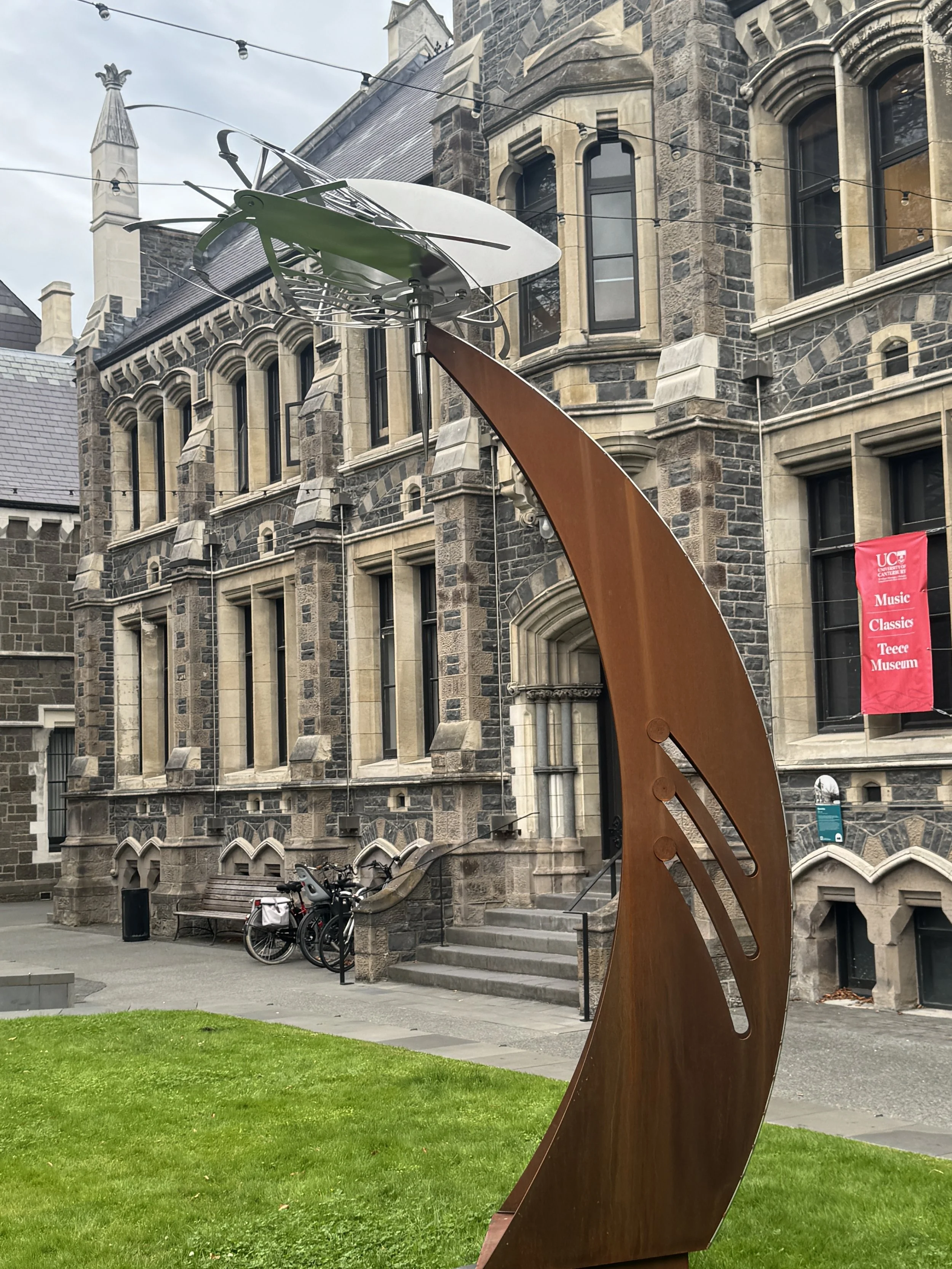
A sculpture by Graham Bennett called The Widening Gyre.
And then outside the Arts Centre in Christchurch, we saw a sculpture by Graham Bennett called The Widening Gyre. The piece is a response to the slowing of the Antarctic Circumpolar Current — the world's largest ocean current, linking every ocean, moving millions of cubic metres of water per second. It is slowing because of climate change. Scientists project a 40% weakening of deep ocean circulation by the 2050s. For New Zealand, that means fisheries disrupted, El Niño and La Niña cycles intensifying, sea levels rising faster, and coastal communities already measuring what they stand to lose. New Zealand is the country closest to the gyre. The effects are not distant. They are geological, oceanic, and above all for residents, intimate.
New Zealand faces no shortage of climate-related challenges, and yet it continues to lead. The country runs on 97% renewable electricity. That's not a talking point; it's a remarkable achievement. Farmers who cite that number aren't wrong to feel that the weight of global targets shouldn't fall equally on those who've already done more. It's a fair argument. But island nations don't get to live by averages. The risks here, from shifting ocean currents to eroding coastlines to intensifying cyclone seasons, are not typical. They're existential.
The postcard version of New Zealand I still carry in my heart as home is innovative, pragmatic, straight-talking, and quietly proud. A place that punches above its weight because it has to.
Shouldn't that version of us — farmers and all — be exactly the people who look at what's coming and decide to lead?
The evidence is all over the road. We just have to connect the dots.