

Sustainability Summer Stocktake
We are six months into 2026 and Sunday was the summer solstice. It feels like time to take stock of where we are in the year and what it might mean for the next six months. Back in January, we wrote our predictions for the year, and at the top of our list was ‘uncertainty as the only certainty’. And of course, how could we go wrong with such a broad summation given the geopolitical situation we find ourselves in! But we certainly did not predict a war with Iran, and we certainly did not predict the impact it might have on electrification strategies around the world. Here’s a review of what happened with some emerging data points on what it could mean and how we see that applying to our three lines of work across Strategy, Impact Measurement and Storytelling for Sustainability.
Strategy that makes Sense
Electrification & the War in Iran
I didn’t predict a war with Iran, but my other half was expecting an announcement during the President’s State of the Union address way back in January, so some informed people were at least aware it was a strong possibility. The war didn’t get going till February, and soon after we learned that the Strait of Hormuz is responsible for up to 20% of oil supply chain flows and 30% of agricultural fertilizer. While this was news to many of us, it was not for military strategists and geopolitical experts. ‘The Power of Geography - Ten Maps That Reveal the Future of our World’ by Tim Marshall, published in 2023, names the Strait and the consequences of conflict with Iran in an eerie prophecy. It’s worth adding to your summer reading list.
For us in the US, the result has been an increase in gas prices and inflation. For other countries like India and South Korea it has meant car-less days. This isn’t the first time we have seen this; in the 70s, car-less days were also a thing. It led to a huge increase in investment in renewable energy (the creation of the Department of Energy and the National Renewable Energy Laboratory), the idea of individual energy consumption reduction and even the creation of Earth Day. Jimmy Carter put solar panels on the White House, saying, “No one can embargo the sun and interrupt its delivery to us.”
Resilience was the driver for renewables back then, and it’s now back again. But this time the cost of solar and renewables is well below fossil fuels, and the innovation across hybrid and EV vehicles gives people way more options to meet the energy transition. Since the war started sales of hybrid vehicles in the US are up 37% and, while sales of EV are down in the US due to the end of federal subsidies, globally they are up and on track to represent 28% of all car sales. So will electrification be the real winner of the war in Iran? Who knows but here’s a link to a great podcast episode from Outrage & Optimism where experts debate if this is a tipping point or just another energy crisis.
So what does it mean for your strategy? In the words of Rahm Emanuel, “Never let a serious crisis go to waste.” Now is a good time to couple resilience rationales with your decarbonization strategy.
Impact that’s Integrated
Data Center & AI Backlash
The other big story this year has been the proliferation of Data Centers in the service of AI. Across the US, community citizen organizers are pushing back on big Tech data center rollouts based on concern for water use, rising utility costs, noise pollution, and e-waste. There are over 180 activist bipartisan groups that have developed in over 40 states, and they have collectively blocked developments worth over $64 million. In a time of declining democratic participation and polarization, it seems this level of coordinated pushback across the political divide is really notable. There is so much antipathy that US citizens would rather live next to a nuclear power plant than a data center.
Meanwhile, productivity hacks through AI dominate the discourse from schoolyards to sustainability conferences. Those in the Sustainability space are being encouraged to use it to streamline reporting burdens and to manage climate risk. Even though using the tools is contributing to the massive 17% increase in energy use worldwide, it is putting a strain on natural resources and utility pricing. Not to mention the impact on the workforce, as some of these AI reporting hacks displace sustainability workers.
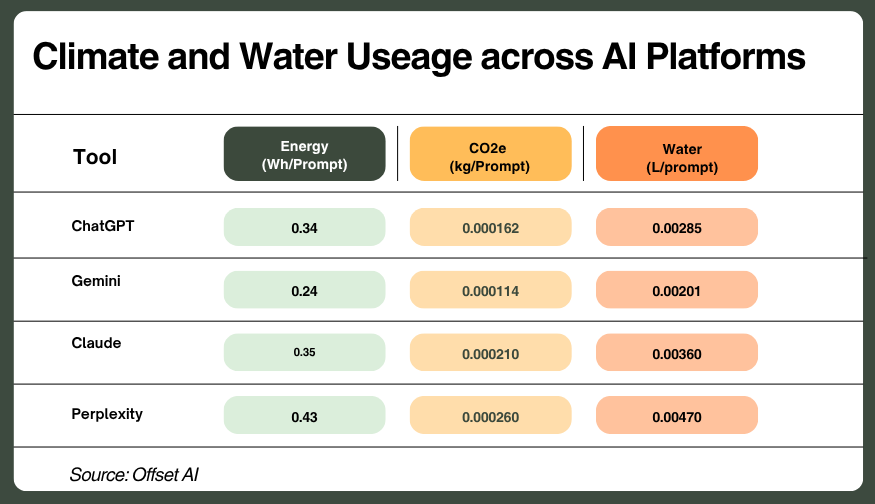
So what’s the solution here? Asking the right questions can drive change in the supply chain. But also developing your own AI policy for you and your team members. Defining when AI is appropriate to use, what model is most efficient for the task in hand, using longer prompts with more information and measuring the environmental impact of the tool. Today, AI companies are not publicly releasing their per-prompt emissions, but that has not stopped researchers from estimating emissions based on available data.
Companies are emerging to help you measure your AI footprint; check out CNaught’s methodology here. They provide a tool, CarbonLog, as a plugin for Claude use for those who want to understand the impact of their AI use. Alternatively, Code Carbon Project has created a a python tool that you can integrate into your workflows to measure carbon for software development in real time. Offset AI also goes a step further by providing a web browser plugin to measure AI use and a portfolio of carbon and water projects to offset those emissions. Below are their estimates on climate and water use per prompt.
Storytelling that Inspires
Affordability Over Morals
Energy shocks and data center backlash have two major things in common: rising gas and energy prices. The impact of these shifts on everyday affordability is everywhere, and it’s likely to be a key lever in the midterm elections. It’s also impacting climate communications.
Al Gore, former Vice President and An Inconvenient Truth lead, has shifted his narrative from the moral reason to act on climate to the impact on your pocketbook. While new research from the Potential Energy Coalition with funding from the Rockefeller Center found that framing around affordability can shift support for clean energy transitions by as much as 10%. Linking the dots between what people care about and what they understand about the world around them is way more impactful than framing in environmental terms alone. The study, Fixing Climate Communications, is the result of research across 85,000 people across multiple countries including the US, and found that messaging framing in terms of personal health, finances, and people you love is way more motivating than empty terms like Net-Zero or Scope 3.
This is hardly surprising because it aligns with decades' worth of research across multiple sectors proving that motivators linked to “my world benefits first, and our world benefits second” are what really drive behavior. It’s consistent with the work Marshall Sustainability has done on electrification in Colorado for Power Ahead Colorado in collaboration with a great team across Karsh Hagan and the Institute for the Built Environment at Colorado State University. While the primary driver for the State for electrification for the built environment is environmental, our research with homeowners found that their primary drivers for adoption are more likely to be benefits around health, comfort, and cost.
Final Summary
So what does this half-year stocktake tell us? Not all aspects of the macro environment are headwinds for the energy transition. Resilience is the driver for change from the Strait of Hormuz to your local utility bill. Measurement is still important, and holding tech companies and ourselves accountable for the carbon cost of AI is critical. Connecting the messaging to what people care about matters more now than ever. To make change stick, drop the Net-Zero jargon and connect to what this means for your business, your family, and your finances. As we head into the second half of 2026, we have an opportunity to meet people where they actually are, connecting the dots between cost concerns and real-world solutions that make sense.
Great sustainability work lives at the intersection of strategy that makes sense, impact that's integrated, and storytelling that inspires. Whatever stage you're at, we'd love to help you connect the dots.
